
Survival Strategies and Health Repercussions in Forced Displacement
APA (7th ed.)
Heidari, S., Chan Yousman, L., Usta, J., Tyrovolas, T., Abu Taleb, H., Whitacre, R., & Adhiambo, M. (2025).
Survival strategies and health repercussions in forced displacement: Findings from a multi-country study on transactional sex.
Liminality Research Consortium, Geneva Graduate Institute.
MLA (9th ed.)
Heidari, Shirin, et al.
Survival Strategies and Health Repercussions in Forced Displacement: Findings from a Multi-Country Study on Transactional Sex.
Liminality Research Consortium, Geneva Graduate Institute, 2025.
This multi-country study examines how transactional sex emerges as a survival strategy in forced displacement contexts, drawing on the lived experiences of people navigating legal precarity, constrained access to services, and economic insecurity. Based on qualitative interviews conducted in Lebanon, Jordan, Türkiye, Greece, and Switzerland, the report explores how transactional sex is shaped by gendered power relations, barriers to health care, and gaps within existing protection systems. The findings document interconnected mental, physical, and psychosocial health repercussions, underscoring the need for responses that better reflect lived realities and structural conditions.
Study type
Multi-country qualitative study
Methods
Participant observation, semi-structured in-depth interviews, key informant interviews, focus group discussion and policy analysis
Sample
261 interviews, 23 focus group discussions, and 73 key informant interviews
Participants
Forcibly displaced people across the gender and sexuality, and key informants
Countries
Lebanon, Jordan, Türkiye, Greece, Switzerland
Focus
Structural Drivers, Gendered Patterns and Health Repercussions of Transactional Sex in Forced Displacement
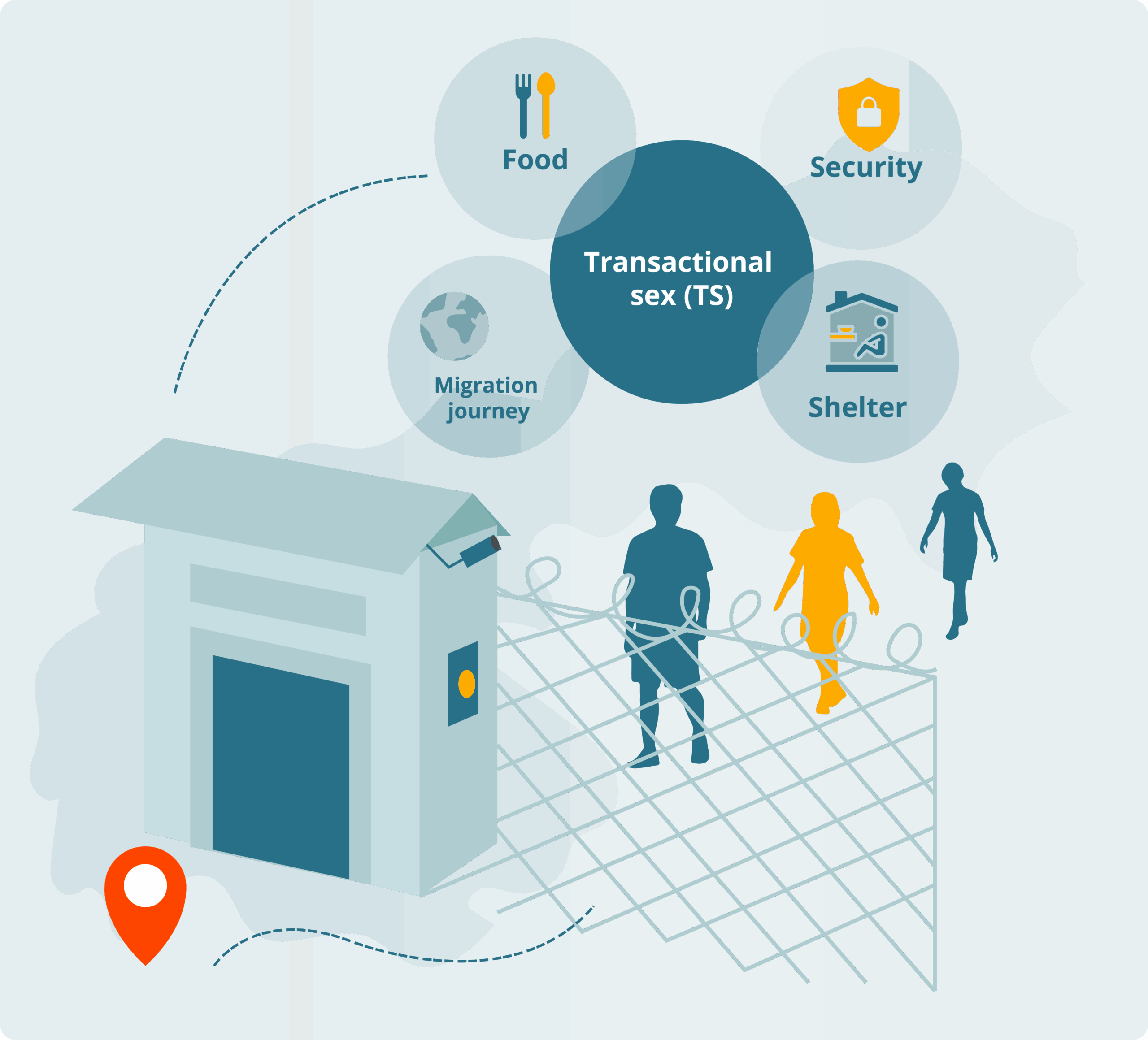
This multi-country report presents findings from a qualitative study conducted in Lebanon, Jordan, Türkiye, Greece, and Switzerland on survival strategies and health repercussions in forced displacement settings, with a focus on transactional sex.

Across all study settings, the report identifies structural conditions that facilitate engagement in transactional sex in forced displacement contexts. These include restrictive legal and migration regimes, exclusion from formal labour markets, inadequate access to basic services and humanitarian assistance, housing insecurity, and persistent economic precarity. These constraints intersect with gendered power relations, discrimination, and stigma — particularly affecting women, men, and people of diverse sexual orientation, gender identity, gender expression and sex characteristics (SOGIESC). Together, these structural drivers shape limited choices and heighten exposure to violence, health risks, and exploitation.

Context
Transactional sex emerges within constrained survival choices shaped by forced displacement, legal precarity, and restricted access to services.

Health repercussions
Participants reported layered physical, mental, and psychosocial health repercussions, often intensified by barriers to care and stigma.

Structural drivers
Gendered power relations, migration regimes, humanitarian gatekeeping, and economic exclusion shape vulnerability more than individual behaviour.

Protection gaps
Existing protection and assistance systems frequently fail to recognise or address transactional sex outside narrow risk frameworks.
Why this report matters
To our knowledge, this is among the first studies to examine transactional sex in forced displacement contexts through such a broad and inclusive lens. Drawing on large-scale qualitative interviews with people with lived experience across gender and sexuality, the report shows how engagement in transactional sex is shaped by legal uncertainty, socioeconomic exclusion, housing precarity, and persistent gaps in protection and health systems. It documents how violence and health harms are structurally produced and unevenly experienced, particularly across the gender and sexuality spectrum. The findings call for rights-based, inclusive responses that move beyond narrow risk frameworks and address the underlying conditions that constrain choice and safety.

Download the full report
The full report is available as a PDF and includes detailed analysis, methodology, and country-specific insights.
Executive summary
This multi-country study examines how transactional sex emerges as a survival strategy within contexts of forced displacement, drawing on the lived experiences of people navigating legal precarity, constrained access to services, and economic insecurity. Based on qualitative interviews conducted across Lebanon, Jordan, Türkiye, Greece, and Switzerland, the report explores the diverse forms transactional sex takes and the structural conditions under which it occurs.
The analysis highlights how restrictive migration regimes, exclusion from formal labour markets, housing insecurity, and limited access to assistance intersect with gendered power relations, discrimination, and stigma — particularly for women, men, and people of diverse sexual orientation, gender identity, gender expression and sex characteristics (SOGIESC).
The findings document interconnected mental, physical, and psychosocial health repercussions experienced by participants, as well as ongoing exposure to violence and harm within these constrained contexts. Overall, the report underscores the need for inclusive, rights-based responses that move beyond narrow risk frameworks and more accurately reflect lived realities and the structural conditions shaping survival strategies in forced displacement settings.
Podcast
Transactional sex in contexts of forced displacement is widely discussed, yet too often framed through narrow lenses and conflated with trafficking, exploitation, or sex work. In this episode of the Sexual and Reproductive Health Matters (SRHM) Podcast, Eszter Kismődi speaks with Dr Shirin Heidari and Professor Monica A. Onyango about the multi-country study Survival Strategies and Health Repercussions in Forced Displacement (2025).
Also available on Apple Podcasts and YouTube.
How to cite
APA (7th ed.) – Reference list
Heidari, S., Chan Yousman, L., Usta, J., Tyrovolas, T., Abu Taleb, H., Whitacre, R., & Adhiambo, M. (2025). Survival strategies and health repercussions in forced displacement: Findings from a multi-country study on transactional sex (Report). Liminality Research Consortium, Gender Centre, Geneva Graduate Institute.
MLA (9th ed.)
Heidari, Shirin, et al. Survival Strategies and Health Repercussions in Forced Displacement: Findings from a Multi-Country Study on Transactional Sex. Liminality Research Consortium, Gender Centre, Geneva Graduate Institute, 2025,
https://liminality.ch/wp-content/uploads/2026/02/2025_Survival-Strategies-and-Health-Repercussions-in-Forced-Displacement_Liminality-Research-Consortium_compressed.pdf
In-text citation (parenthetical): (Heidari et al., 2025)
In-text citation (narrative): Heidari et al. (2025)
When using findings or excerpts from this report, please ensure it is appropriately cited. Proper citation supports responsible knowledge sharing and acknowledges the contributions of participants and researchers.